FIRST-YEAR WRITING ~ ADVANCED WRITING ~ SERVICE-LEARNING
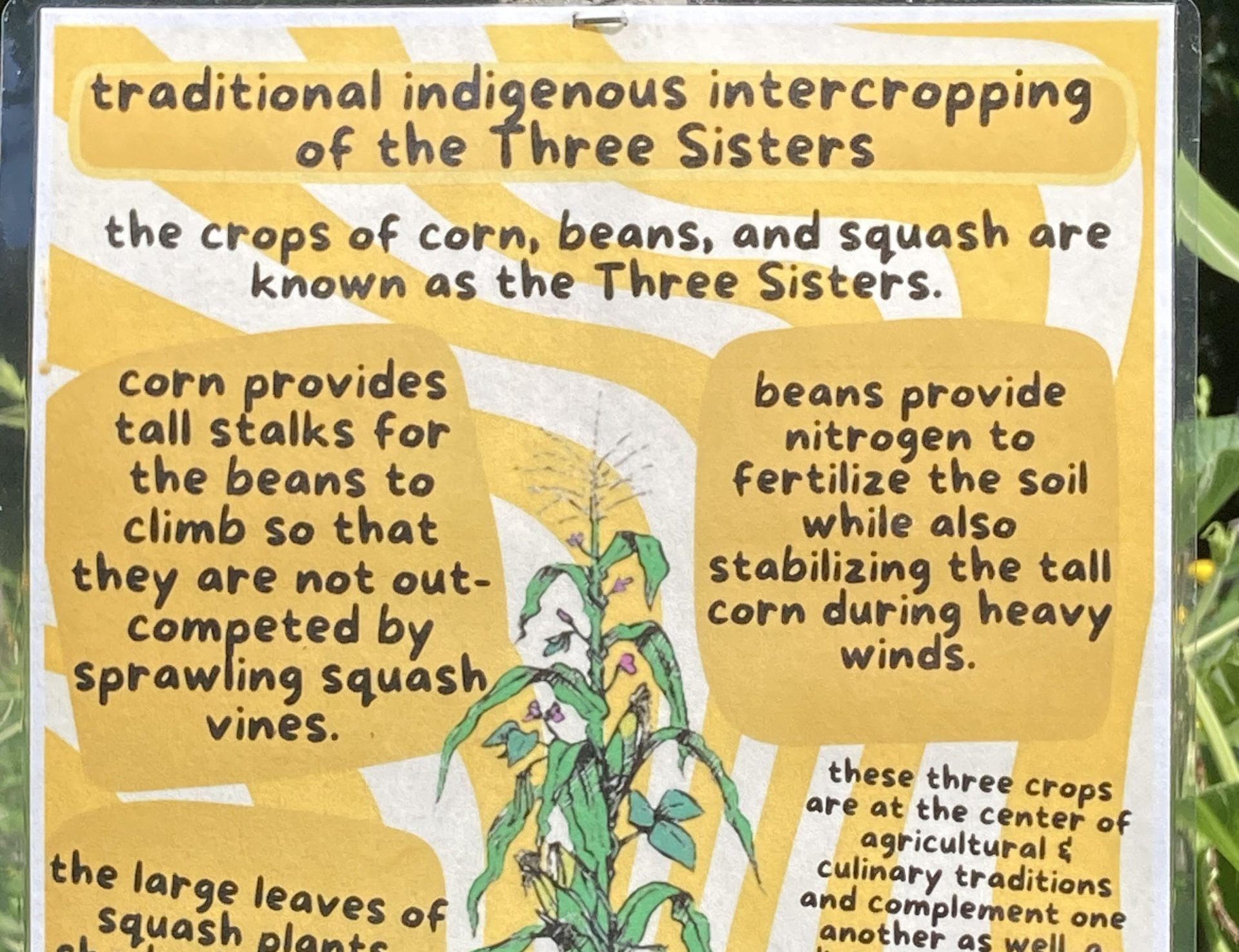
I have taught courses focused on the topic of “Food Justice” for both First-Year Writing and Advanced Writing many times. This is also the course I have coordinated with community organizations the most often as a service-learning course. From the beginning of my time living in Boston, I have volunteered myself with several of the organizations that my students also work with. These include Lifeboat Boston Food Pantry—a truly grassroots operation that is run entirely by volunteers and community members—and an urban farm on Thornton Street run by Haley House. The photo above is one of the informational artworks posted around the farm: it explains the indigenous agricultural practice of planting corn, beans and squash together known as “The Three Sisters.” In Robin Kimmerer’s words, this practice is “the genius of indigenous agriculture. . . . Together these plants— corn, beans, and squash—feed the people, feed the land, and feed our imaginations, telling us how we might live.“
The paragraphs below are drawn from the Course Description:
Thematic Framework: The idea at the heart of this course is a paradox: there is nothing more familiar to us than food. What and how we eat is essential to our individual identities, as well as our connections to family and community. And yet the production of food is a total mystery to millions of American consumers. In the process of investigating that paradox, we will bring the interdisciplinary framework of “food justice” to the critical reading and writing we will accomplish this semester.
One helpful way of defining food justice is any work that supports “communities exercising their right to grow, sell, and eat food that is fresh, nutritious, affordable, culturally appropriate, and grown locally with care for the well-being of the land, workers, and animals” (Alkon & Agyeman, 2011). Students, scholars, and community members who are interested in food justice bring knowledge from many different disciplines to that work––agricultural research, economics, environmental studies, sociology, animal studies, documentary filmmaking, public health, history, and others. One thing that these people share is a recognition that our current food systems often exacerbate existing problems of social inequity and long-term environmental health. So they also share an interest in creating alternatives to those systems, often by revitalizing local traditions of farming and food production.
Community-engaged learning (Boston): since this section has been designated as a “service-learning” section of Advanced Writing, all students will participate in activities throughout the semester to support a local non-profit dedicated to alleviating food insecurity and minimizing food waste, such as Haley House, The Daily Table, Community Servings, and Lifeboat Boston Food Pantry. These organizations and others participate in city-wide distribution of surplus food to community members in need. Building on collaborative projects initiated by students in previous semesters, students will both deepen their understanding of course materials and use their composition and communication skills to support the mission of these exemplary local organizations.